This email address is being protected from spambots. You need JavaScript enabled to view it.
Introduction
This is the Plagiarism Policy of Kennedy College, and sets out how we address any issues
regarding the authenticity of work submitted by a student for assessment. We strive to be
a fully inclusive organisation and achieve consistency of good practice across the College.
The College has an obligation to its students, employers and society in general to ensure
that the qualifications its students receive are a fair and accurate representation of their
work, and of the knowledge and skills attained. Plagiarism and other forms of cheating
undermine the value of qualifications for all concerned because they undermine their
credibility. If a student passes an assessment, or gets a qualification, by unfair means
then this is unfair to those who have achieved the same qualification fairly.
If left unchecked plagiarism is a serious threat to the integrity of learning programs, and
thereby a threat to the reputation of the college. In addition students who succeed in
achieving their qualifications having knowingly submitting plagiarised work risk being
poorly prepared for their careers.
This policy provides guidelines on how to deal with the issue. It is important all teaching
staff and students in the college carefully read the policy together with the guidance and
warnings set down by the Joint Council for Qualifications (JCQ).
Plagiarism is the notion of a student taking someone else's intellectual effort and
presenting it as their own. The JCQ defines plagiarism as:" The failure to acknowledge
sources properly and/or the submission of another person's work as if it were the
candidate's own." In other words, it is a form of cheating and if proven will be the person
will be subjected to the College's Student Disciplinary Procedure.
Plagiarism is the submission for assessment of material (written, visual or oral) originally
produced by another person or persons, without acknowledgement, in such a way that
the work could be assumed to be the student's own. Plagiarism may involve the
unattributed use of another person's work, ideas, opinions, theory, facts, statistics,
graphs, models, paintings, performance, computer code, drawings, quotations of another
person's actual spoken or written words, or paraphrases of another person’s spoken or
written words
All staff carrying out internal or external assessed work must make students aware of the
guidelines on plagiarism. This is part of the whole college student induction.
All tutors and teachers before the main examination and coursework period must make
students aware of the college plagiarism and assessment malpractice policy.
Guidance on referencing for students where appropriate
All students must be aware of how to cite any work that is not their own using the Havard
Referencing System. All resources used must be included in a bibliography.
It is vital that all internet sites are also clearly shown. In particular:
The sources of ideas and all resources used in a reference list/bibliography must
always be cited.
Verbatim, i.e. word for word, or near verbatim extracts from other resources, e.g.
textbooks and the internet, must not be reproduced.
Quotations shorter than two lines (approx) or 20 words (approx) may be included in
inverted commas in the normal run of text (source clearly shown in the Bibliography)
Longer quotations should be indented and could be shown in a different font
Quotations longer than 200 words should be avoided, as should their over-use
Appendices should be used for substantial elaborations, e.g. copies of questionnaires,
documents, and newspaper reports
Any charts, graphs and tables should be put them in the main text, but they must be
numbered and referenced
The Harvard system should always be used and references should always be
consistent
Identifying plagiarism
If text, data, drawings, designs or artefacts are used without properly acknowledging who
produced the material, then there is a risk of being accused of plagiarism. This can be
avoided by making clear the sources of information used (e.g. books, articles, interviews,
reports, 'www' reference, or government publications). All must be properly referenced
(as described in the Induction Programme) not only in a reference list/bibliography but
also by citations and quotations.
Teaching teams will routinely use online plagiarism software and personal interviews to
help determine the authenticity of submitted work and will publicise this to students
through course induction and handbooks to deter them from deliberately making
plagiarised submissions.
Plagiarism covers both direct copying and copying or paraphrasing with only minor
adjustments:
a direct quotation from a text must be indicated by the use of quotation marks and
the source of the quote (title, author, page number and date of publication);
a paraphrased summary must be indicated by attribution of the author, date and
source of the material including page numbers for the section(s) which have been
summarised.
Students will be required to submit their work through the college’s ‘Turnitin’ software.
This is a plagiarism detection service and will check any submitted work for its originality.
This software automatically generates a receipt so there is certainty that the work has
been submitted correctly and within the deadlines set by course tutors. This service uses
extensive databases of material from a range of sources, including the work of other students, in order to detect when the material submitted by a student has been copied
from another source. This system is very powerful and provides an aid to the judgement
of College staff. However, the responsibility for judging whether plagiarism has taken
place remains with teaching staff.
Double-counting: Students are also not permitted to re-present any assessment already
submitted for one module as if for the first time assessment in another module. Double
counting of assessed work is not normally allowed. If submitting work previously included
in another assessment the student should attribute the section of text from the earlier
work. This may be taken into account by the markers.
Action on Detecting Plagiarism
Any instance of proven plagiarism is regarded as serious misconduct under the College's
Student Disciplinary Procedure and the matter will be subject to that Procedure and
reference will be made to the rules and regulations for coursework and examinations of
the Awarding Body or Partner University.
Teaching staff that suspect any student's work, which is not examination-based and is
plagiarised should deal directly with the issue. If a student repeatedly offends the issue
should be reported to the Curriculum Manager and Teacher. The Curriculum Manager will
see the student and make them fully aware of the penalties imposed by the exam board
and monitor the student's work. If the plagiarism still continues the Awarding Body should
be further informed.
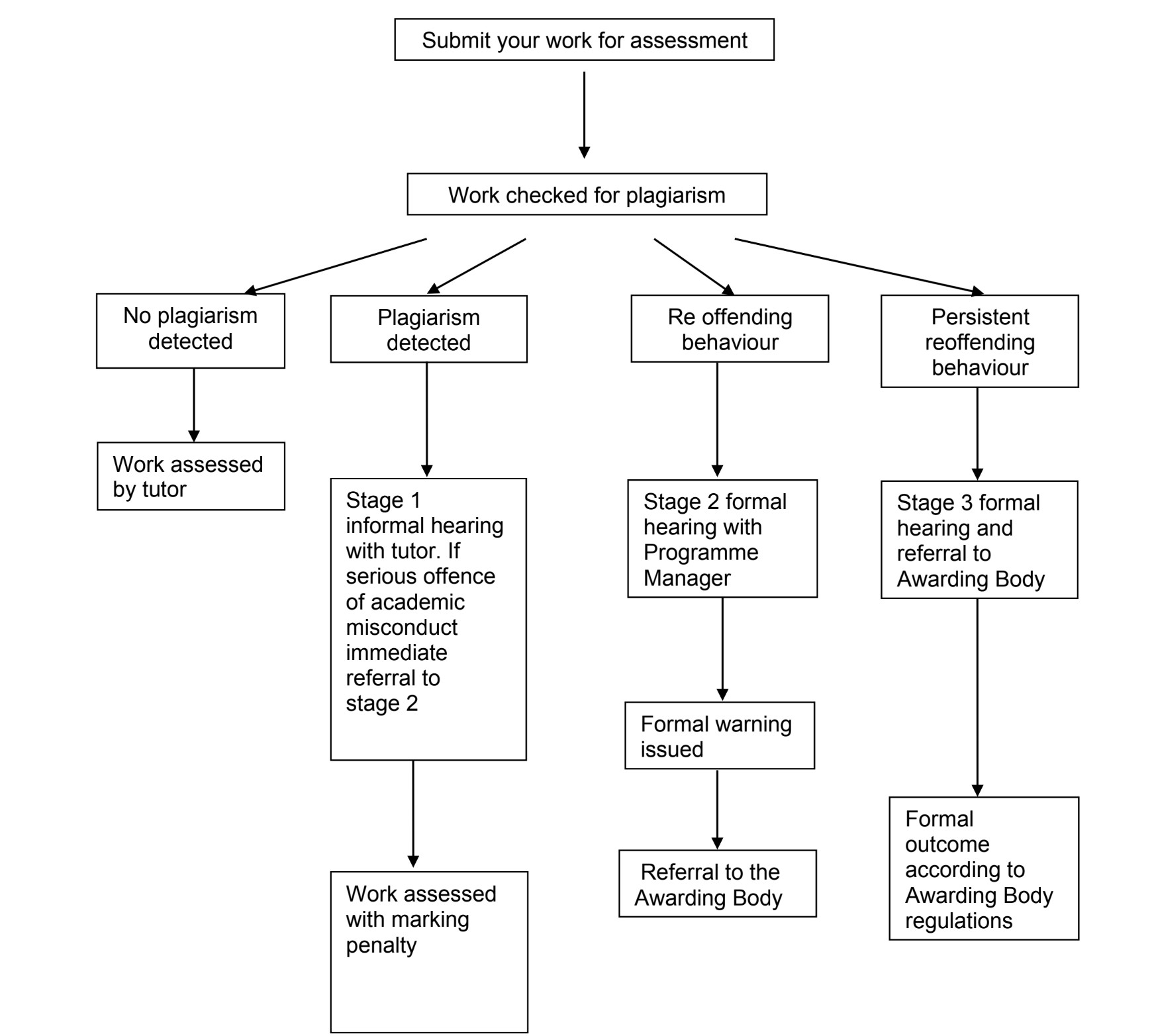
The outcomes of Turnitin analysis is used a guide for the appropriate stage of the Student
Disciplinary Procedure. Individual tutors will investigate the plagiarism further and act as
per the disciplinary procedures below:
Stage 1: If plagiarism is detected, the tutor will meet with the student to discuss the
findings. If the plagiarism would have altered the result obtained by the student if it
had been undetected then at the very least the student will be penalised within the
marking process. If it is clear that the plagiarism was minor and did not constitute
intentional cheating, then guidance and support should be provided to address any
underlying issues. This might include revision of appropriate referencing practice.
The student should also be informed clearly of the unacceptability of plagiarism and
the need to abide by accepted practice.
Stage 2: Re-offending behaviour: formal hearing with the Programme Manager,
which could result in a referral to the Awarding Body
Stage 3: Persistent reoffending; the case is referred to the awarding body plagiarism
board
Students' Plagiarism Procedure
Cookies & Privacy
This website uses cookies to ensure you get the best experience on our website.